
Shipping stamped parts and stamping dies
Export shipping for custom metal parts
Stamped parts and stamping dies have different shipping needs. WenXinDa connects pack quantities, edge and surface protection, part identification, tool preservation, and handover documents with the agreed order. Define whether the shipment contains production parts, a die, trial samples, or a combined package.
01 Trade terms
Choose a delivery term with a clear handover point
Incoterms® 2020 rules define how seller and buyer share delivery tasks, costs, and transport risk. Naming the place precisely keeps the quotation clear—for example, collection from a specified address or delivery to a named receiving location.
| Term | Delivery / risk transfer | Planning note |
|---|---|---|
| EXW | Goods made available at the named place, not loaded. | Buyer arranges collection and export clearance. Check practical export responsibilities. |
| FCA | Delivery to the buyer’s nominated carrier at the named place. | Seller clears export. Specify the place precisely; loading duties depend on that place. |
| FOB | Goods on board the vessel at the shipment port. | Sea or inland waterway only. Buyer arranges main freight. |
| CIF | Goods on board the vessel at the shipment port. | Seller pays carriage and required insurance to the destination port. Risk transfers earlier, at shipment. |
| DAP | Goods at the named destination, ready for unloading. | Buyer handles import clearance and import duties/taxes. |
| DDP | Import-cleared goods at the named destination, ready for unloading. | Seller handles import clearance and duties/taxes. Destination feasibility must be checked before quoting. |
FCA is often suitable for containerized or multimodal shipments. FOB and CIF apply to sea or inland waterway transport. DDP requires a workable arrangement for destination import clearance and taxes, so those responsibilities are addressed before booking.
Reference: ICC rules for any mode of transport and ICC rules for sea and inland waterway transport. Confirm the selected rule and named place in the sales agreement.
02 Packaging
Protect dimensions, finishes, and part identity
Protective packing starts with the item and its vulnerable features. Small stamped parts may need counted packs, separators, and protection for tabs or contacts. A die needs a separate plan for preservation, restraint, lifting access, and its agreed spare components or records. Confirm the packing scope before booking freight.
| Packing priority | Practical protection |
|---|---|
| Contact between parts | Separators or individual wrapping keep finished faces, threads, and edges from rubbing against other parts. |
| Corrosion or moisture | Material-compatible protection takes transit, moisture exposure, and expected storage time into account. |
| Weight & movement | Suitable cartons, crates, or pallets keep the load restrained and compatible with the receiving equipment. |
| Receiving identification | Part number, revision, quantity, batch reference, and package numbers connect the contents with the packing list. |
| Wood packaging | Solid-wood packaging is reviewed against the destination treatment and marking requirements. |
| Assemblies & kits | Part orientation, secured loose items, and kit identification help complete sets arrive ready for receiving. |
03 Documents
Keep shipping and quality documents together
A consistent document set helps freight and receiving teams identify the order without repeated clarification. We connect commercial details, package quantities, transport information, and the agreed quality records before dispatch.
Commercial invoice
Identifies buyer and consignee, goods, value, currency, origin, and the agreed delivery term. Customs classification is aligned with the responsible broker or importing party.
Packing list
Connects part quantities with cartons or pallets, package marks, net and gross weights, and packed dimensions.
Transport document
Provides the shipment reference for the selected route, such as a courier waybill, air waybill, or bill of lading.
Material records
Material certificates and batch references are included where specified in the order, keeping the records connected to the supplied parts.
Inspection records
Dimensional, first-article, or other agreed reports support your quality review and any approval needed before shipment release.
Origin or destination documents
Destination-specific certificates and declarations are addressed during order planning so preparation fits the shipping schedule.
04 Schedule
Work backwards from the required arrival date
Your required arrival date guides the delivery plan. We separate manufacturing, finishing and inspection, packing, and transport so sample approvals or freight arrangements are visible before they become last-minute obstacles.
- 01
Material & production
Confirm material availability, die design and trial stages, sample approval, and the stamped-part release before setting the dispatch date.
- 02
Finishing & inspection
Allow for finishing operations, agreed measurement, documentation, and any shipment release requirement.
- 03
Packing & collection
Confirm package details, labels, booking, pickup arrangements, and documents needed for export.
- 04
Transit & receiving
Review the current route with the forwarder, including customs clearance, onward delivery, and receiving appointments.
05 Part-specific protection
Use protection that matches the component
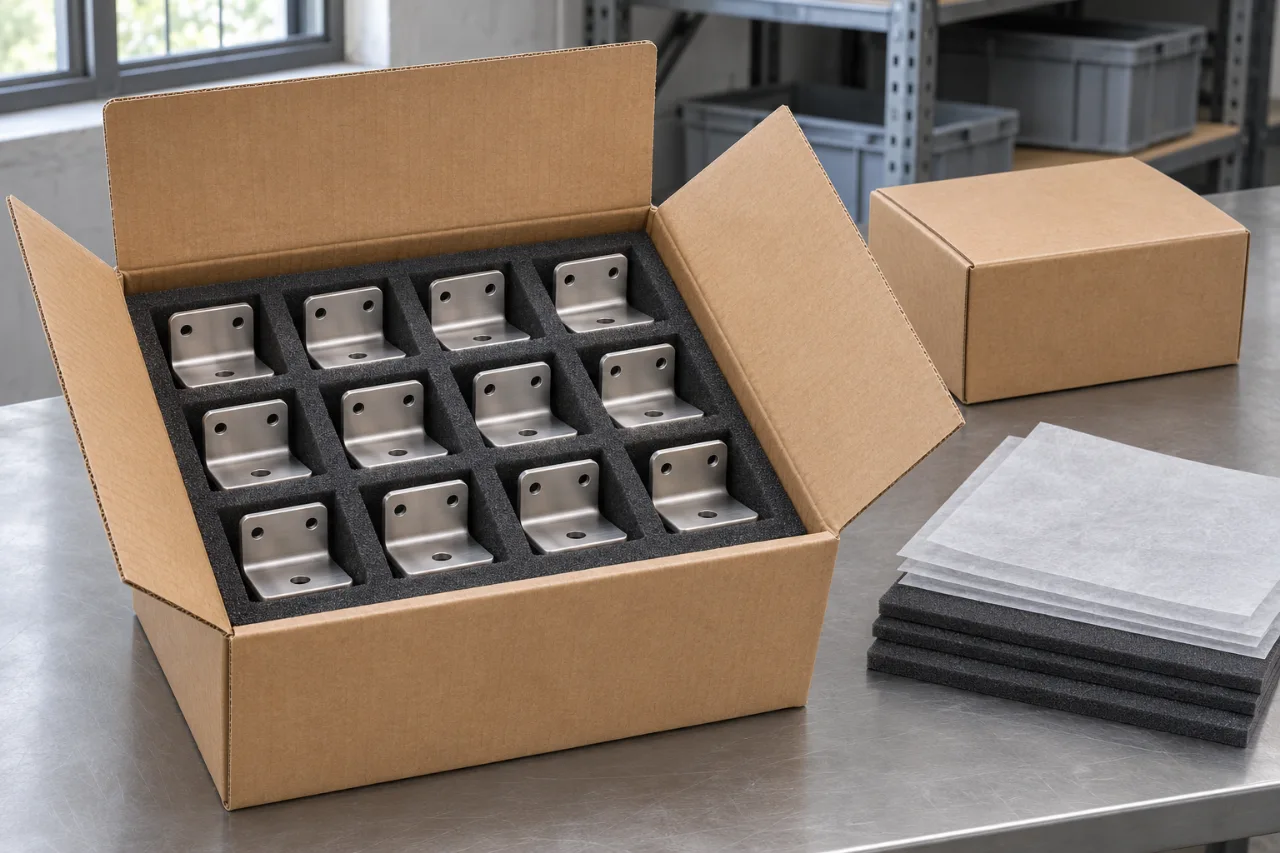
A tray of contacts, formed brackets, and a stamping die face different risks in transit. Match the packing to working edges, vulnerable tabs, finish, weight, and receiving equipment so the shipment preserves the condition accepted during inspection or trial.
| Part feature | Transit risk | Packing approach |
|---|---|---|
| Small stamped parts | Mixed revisions, counting errors, bent tabs, or entangled parts. | Group parts in counted packs or trays, label revisions clearly, and separate batches and vulnerable tabs. |
| Stamping die or tool package | Corrosion, movement, damage to working surfaces, or missing loose components. | Agree preservation, restraint, lifting and handling instructions, itemized loose parts, tool identification, and handover records. |
| Cosmetic sheet panels | Face-to-face abrasion, fingerprints, denting, or coating rub. | Protect visible faces with suitable film or dividers and choose an orientation that limits rubbing and dents. |
| Supporting machined features | Impact, debris, contact corrosion, or damage to a mating edge. | Protect openings and threads, separate contact surfaces, and use preservative compatible with the material and application. |
| Heavy assemblies | Movement inside the crate, unsafe lift points, or distortion under stacking. | Restrain the assembly, identify lifting requirements, and match the package to loading and receiving equipment. |
Send your packaging or label standard with the drawing. Integrating it into the order plan keeps protective materials, pack quantities, and receiving information consistent.
06 Handover points
Keep collection, transport, and receiving coordinated
The shipping plan connects three handover points: release from production, delivery to the carrier, and receipt at destination. Part acceptance, payment, and ownership are set out separately in the commercial agreement.
Before collection
Confirm packed quantity, package count, dimensions, weights, marks, booking reference, and whether inspection records are required for shipment release.
At carrier handover
Identify the named place and who arranges loading, export clearance, main carriage, insurance, and transport documents under the agreed term.
At destination
Confirm who handles import clearance, duties and taxes, final delivery, unloading, and the receiving appointment. Share any damage-reporting procedure.
07 Shipping RFQ
The details needed for a useful freight quotation
A complete destination and shipment scope allow meaningful comparison of freight options. Share the address or port, delivery timing, preferred trade term, and any receiving restrictions with the manufacturing RFQ.
- 01
Named delivery place
Provide the full ship-to address or named port and the contact who can receive, clear, and unload the goods.
- 02
Trade term and route
Specify the intended Incoterms rule and edition, transport preference, forwarder details, and any buyer-controlled booking.
- 03
Date and split policy
Separate the required arrival date from the date manufacturing must finish. Say whether partial shipments or consolidated releases are acceptable.
- 04
Packing and documents
Attach packaging, label, invoice, packing-list, material-record, and inspection-document requirements.
- 05
Import requirements
Ask the responsible broker to confirm classification, destination restrictions, taxes, and any product-specific document requirements.
08 Buyer FAQ
Before booking freight
Can shipping be quoted before the final part is ready?
Does DAP include import duties?
Can inspection documents travel with the shipment?
Ready for your receiving floor
The job is not finished when the parts leave the press.
A shipment needs to preserve the dimensions, working surfaces, identity, and records your team approved. Plan the packing around the part and the way your receiving and assembly teams will use it.
Clips and thin formed parts
Protect spring features and thin flanges from loads created by bulk packing. Discuss tray, layer, or separation needs and the number of parts handled as one pack. Keep part identity and quantity visible without requiring your receiving team to empty the whole container.
Plated or cosmetic components
Keep accepted surfaces from rubbing during handling and transit. Identify the working face, visible face, and surfaces that can touch. Review interleaving, sleeves, or separated packing with the finish requirements and add an approved packing reference to the shipment specification.
Heavy stamping dies
Build the handling plan around actual tool weight, dimensions, lifting points, and the receiving equipment. Protect working surfaces and loose components, identify the tool and its accessories, and connect the case list with the agreed tool drawings and handover records.
Mixed part-number releases
Separate part numbers and revisions, then identify quantities, package sequence, and purchase-order references. Put inspection documents and material records where your receiving team expects them. An advance electronic document pack can support the release review before the freight arrives.
Send the ship-to address, receiving hours, unloading arrangements, package limits, and any label template with the RFQ. Add the requested arrival date and the party arranging freight. These inputs let the manufacturing plan, packing method, and delivery scope support the same receiving process.
Next step
Bring manufacturing and delivery into one quotation
Send your stamped-part drawing or die scope, quantity, delivery destination, and required arrival date. Add any packing or routing instructions so the quotation covers the complete handover.