

Rigorous Traceability: Handling Exotic Alloys in Aerospace Metal Stamping
Beyond Commercial Grade: The High Stakes of Aerospace and Defense Metal Stamping

Modern aerospace manufacturing environments maintain strict cleanliness and temperature control to ensure dimensional stability.
A single microscopic fissure in a stamped bracket is all it takes to ground an airframe, regardless of how competitive the per-part cost was on paper. In high-vibration, high-stress defense environments, mechanical components endure continuous harmonic resonance, rapid thermal cycling from -55°C to over 200°C, and sudden high-G loads. Under these dynamic stresses, residual stress or unchecked work-hardening from the metal stamping process triggers sudden structural failures. A component that looks flawless under basic visual checks can easily harbor internal delamination, turning a simple structural bracket into an active liability once deployed.
Achieving aerospace-grade reliability requires shifting from basic dimensional checking to absolute control over material deformation—a threshold where standard commercial stamping protocols fall short. Commercial operations focus on high throughput, typically holding standard tolerances of ±0.2 mm. Structural aerospace components, however, require tight-tolerance precision down to ±0.02 mm and strict grain-flow preservation. Commercial presses lack the active tonnage monitoring, progressive die cooling, and thermal control needed to stamp tough alloys like titanium, Inconel, or aerospace aluminum without inducing micro-fractures. Standard statistical QC is also insufficient when flight-critical parts require 100% non-destructive testing and complete heat-lot traceability.
Navigating these extreme demands requires a technical stamping partner that treats tooling engineering and metallurgy as a single discipline. WenXinDa meets this high-reliability requirement by providing custom precision metal stamping services backed by advanced progressive die engineering and strict quality assurance. By integrating in-die sensor monitoring and robust material traceability, WenXinDa ensures structural integrity from the first stroke to final delivery. For procurement teams auditing potential suppliers, the rule is simple: if a supplier cannot immediately produce real-time tool-wear logs and heat-treat calibration records on request, they are stamping for commercial use, not aerospace survival.
Titanium, Inconel, and Cobalt: Managing the Work-Hardening of Exotic Alloys
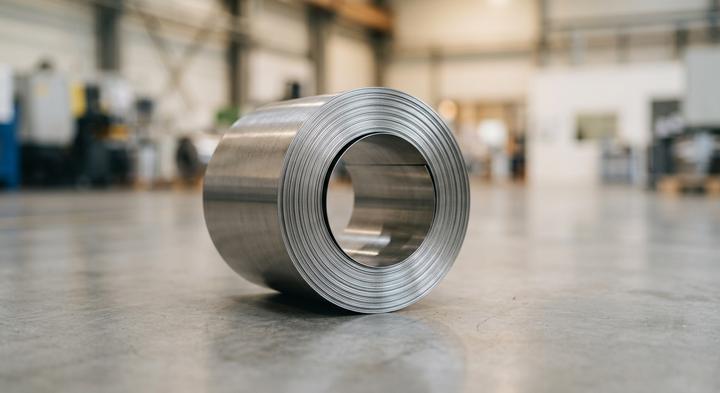
High-performance exotic alloy coils undergo strict material inspection before entering the press line.
(占位段:本节生成未返回可用 markdown — 反思/排版后仍无正文;请在本任务 LLM 日志中查看本节 section_v1,并单段重生成。)
Military-Grade Traceability: From Raw Coil Mill Certificates to the Part Marking Line
A line supervisor at 06:00 AM halts the feed on press three because a barcode scan on an incoming titanium coil fails to match the Mill Test Report to the Defense Contract Management Agency requirements. That 30-second verification delay on the shop floor prevents a million-dollar sorting campaign later. In military metal stamping, the path From Raw Coil Mill processing to the final Part Marking Line must be physically unbroken. If an auditor cannot map a stamped bracket’s chemistry back to the specific furnace melt where it was born, the part does not exist as far as the military is concerned.
Volume Munitions Parts: Keeping Pace with Continuous Heat Number Integration When Press Speeds Double
When stamping fuse housings at 120 strokes per minute, a raw material coil changeover introduces massive compliance risk if handled manually. The operator cannot simply pause the line to scribble down a new batch code without destroying cycle cadence. To handle Volume Munitions Parts while Keeping Pace with production quotas, the press control system utilizes automated Continuous Heat Number Integration When the decoiler transitions between raw alloy feeds. By linking the progressive die’s physical stroke counter directly to the incoming coil’s chemical pedigree, the automated line laser-etches a 2D matrix onto each part before it drops into the collection bin. This guarantees that if a batch fails testing downstream, only the specific parts stamped from that identical mill run are quarantined.
Vibration Structural Clips: Validating Integrity Under Dynamic Aerodynamic Loads
Airframe structural clips face relentless harmonic resonance and rapid thermal shifts that will turn any microscopic surface defect into a catastrophic crack. Visual checks on the stamped edges do not catch subsurface material flaws introduced during cold-working. For these critical Vibration Structural Clips, Validating Integrity requires a combination of magnetic particle inspection on steel alloys and liquid penetrant testing on non-ferrous metals, linked to both non-destructive and Destructive Testing For tensile strength verification. Every batch is backed by a complete First Article Inspection package documenting grain direction, micro-hardness profiles, and springback calculations. This technical dossier ensures that when the part is bolted onto a fuselage, its structural behavior is predictable down to the micro-strain.
Progressive Die vs. Deep Draw Stamping: Selecting the Process for Thin-Walled Components
Tooling amortization limits, not part complexity alone, dictate whether a thin-walled component belongs on a progressive die or a deep draw transfer press. While engineering teams often obsess over the geometric limits of drawing metal, the commercial reality of a project is decided by how fast the upfront mold cost depreciates against the production run.
Any part with a draw depth greater than its diameter must automatically go to a deep draw press.
While deep draw forming excels at extreme depth-to-diameter ratios, many progressive dies handle moderate draw steps using consecutive, shallow forming stations. The choice hinges on material stretch and structural integrity. For thin-walled components, a Progressive Die can stretch the material across multiple active stations while keeping the carrier strip intact, provided the material has sufficient elongation properties. Bypassing a progressive die too early means paying a premium for transfer press setups when a multi-station layout could have managed the depth.
High initial tooling costs for progressive dies always make deep drawing the cheaper entry point for low-volume runs.
This oversimplification ignores the high setup and cycle-time penalties of transfer systems. Deep Draw Stamping tooling for complex Walled Components might appear less intensive because it lacks an integrated carrier strip, but the individual transfer fingers, nesting dies, and alignment stations add significant engineering hours. If a production run is scheduled for recurring monthly batches rather than a single massive drop, the faster stroke rate of a progressive setup often recoups the tooling delta within the first two quarters.
Progressive stamping always wastes more material because of the carrier strip.
While a carrier strip is necessary to transport the part through consecutive die stations, a well-engineered strip design minimizes web scrap to under 15% of the total coil width. Conversely, deep draw blanks must be cut with enough material margin to allow holding pressure at the draw sleeve, which often produces significant edge trim. At WenXinDa, tool designers analyze the nested strip layout before cutting steel, ensuring the progressive die carrier serves as a functional stabilizer without acting as a profit sink.
Has your engineering partner run the strip nesting analysis to prove which process actually yields the lowest total cost per part over the lifetime of the program?
Preventing Dimensional Drift: Tool Wear Management in Long-Run Production
How do aerospace metal stamping manufacturers control dimensional drift during high-volume production runs?
Maintaining a consistent ±0.05 mm tolerance across thousands of stroke cycles requires a rigorous system of real-time press feedback and preventative die maintenance. When stamping tough, abrasive alloys like Inconel or titanium, the physical breakdown of the die’s cutting edge is not a matter of if, but when. As the tool edge rounds, the shear-to-break ratio shifts, leading to increased burr heights, micro-fractures, and dimensional creeping that manual QA processes fail to catch until batches are already ruined.

Quality planning and tool wear tracking form the core of reliable long-run metal stamping projects.
Tool Wear Vetting Checklist for High-Volume Projects
| Ask | Expected evidence | Red flag | Responsible party |
|---|---|---|---|
| Tool maintenance schedules | Verification of documented sharpening and polishing logs matched directly to physical stroke counters on the press (e.g., service scheduled every 50,000 cycles for hard alloys). | Tooling is run continuously until visible flash, excessive burrs, or physical micro-fractures appear on the finished parts. | Lead Tooling Engineer / Maintenance Supervisor |
| In-die sensor integration | Live or historical strip layout monitoring data showing automated press shutoffs during material drift, strip lifting, or slug pulling. | Relying purely on post-run manual micrometer checks or end-of-batch inspections to catch dimensional deviations. | Quality Control Manager / Production Operator |
| Tolerance capability metrics | Historical Cp and Cpk study reports demonstrating a process capability index of $\ge$ 1.33 across a continuous production run of at least 10,000 parts. | General, broad statements of quality compliance without accompanying statistical process control charts or batch-to-batch run data. | Lead Metrologist / QA Lead Engineer |
| Scrap and slug-pull control | Mechanical design drawings of slug-retention features (e.g., vacuum-assisted dies, barbs) paired with real-time strip-feed sensors. | Assuming raw visual checks prevent slug damage; lack of integrated safety shutoffs when a scrap piece stays stuck on the die surface. | Tool Designer / Set-up Technician |
For critical defense and aerospace components, relying on manual metrology at the end of a shift is an unacceptable liability. Our engineering team at WenXinDa mitigates this by embedding electronic sensors into our progressive dies to detect die-stripping anomalies and material deflection instantly before they result in out-of-tolerance parts. On a production run of 100,000 parts, a progressive die with integrated carbide inserts and titanium carbonitride (TiCN) coatings will maintain tool sharpness far longer, but we still force hard stop intervals at every 50,000 strokes to verify edge radii under a 50x microscope. This combined approach of inline sensor monitoring and proactive tool maintenance ensures that dimensional drift is controlled before a single out-of-tolerance part reaches the collection bin.
Vetting Your Aerospace Stamping Partner: Critical Questions for the RFQ and Technical Audit
While securing a complete First Article Inspection package proves a supplier can get a single batch right, translating that compliance into a repeatable production run requires grilling them long before the tooling is cut. When you are sourcing titanium, Inconel, or cobalt-chromium, the real risk isn’t just press capacity—it’s raw material supply security. Ask to see their sub-tier mill relationships. If a stamping partner cannot show documented, long-term allocations with accredited mills, your defense contract is one supply disruption away from a three-month halt. During the design for manufacturability (DFM) review, push past the standard ‘we can make this’ boilerplate. A seasoned engineering team will look at your exotic alloy CAD files and immediately debate the springback calculations, the forming radius, or where the material will thin and tear under high-tonnage progressive die runs. If they aren’t suggesting minor adjustments to preserve your progressive die’s lifespan, they aren’t prepping for aerospace; they are treating your exotic alloy like mild steel, and you will pay for that oversight in cracked parts.
An on-site technical audit is where the marketing copy meets the shop floor reality. Watch the presses: if they rely on manual post-process inspection to catch out-of-tolerance parts, you are gambling on the operator’s stamina at the end of a long shift. High-reliability stamping requires real-time, in-die sensor monitoring to stop the press the millisecond a tolerance drifts. To take the guesswork out of your next RFQ, WenXinDa’s engineering department offers a direct, low-friction entry point: send us your titanium or exotic alloy drawings for a formal DFM and feasibility review. We won’t send back a generic quote sheet; our tooling specialists will return a detailed manufacturability report analyzing your specific custom tolerances, raw material flow limits, and progressive forming challenges. It is a practical, zero-commitment way to test our technical depth before you sign off on a tooling budget.