
Surgical-Grade Precision: Material Traceability in Medical Metal Stamping
The Material Traceability Illusion in Medical Metal Stamping
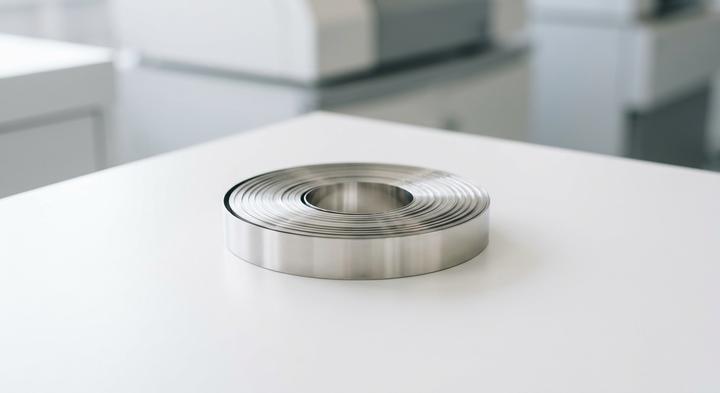
Physical material verification starts with immaculate strip-coil quality control before the stamping process begins.
A quality manager signs off on an incoming batch of 316L stainless steel coil, notes the ISO 13485 stamp on the paperwork, and clears it for production. Two hours later, a progressive die stamping surgical stapler anvils begins micro-fracturing parts because the coil’s tensile strength spiked by 40 MPa. On the procurement portal, everything looked flawless—the mill run sheet claimed perfect chemical compliance. But generic industrial quality control routinely fails FDA Class II and Class III medical device standards because it treats material verification as a static, up-front administrative gate. An ISO certificate on a factory wall does not guarantee that the metal running through a high-speed press at 2 PM behaves exactly like the sample tested at the mill three months ago.
The reality is that a 316L surgical stapler anvil demands absolute physical traceability from the initial master coil slitting, through high-speed stamping, to post-passivation testing. The primary failure mode in these micro-components isn’t a complete mismatch of alloy grade; it is microscopic physical deviation. A variance of just 0.01mm in coil thickness alters the localized stamping pressure inside the progressive tool. This minor shift prevents the material from flowing predictably into the critical bent radii. Under pressure, it causes micro-cracks that easily bypass automated vision sorting systems, only to fail catastrophically under the physical loads of an operating room.
To manage this risk, Medical Metal Stamping At WenXinDa couples continuous metallurgical validation with a strict physical sample retention system for every single coil run. Instead of relying blindly on static mill sheets, production lines map real-time press tonnage monitor data against physical master retention samples sliced from both the leading and trailing ends of each slit coil. If the tonnage spikes or drops, the run stops immediately, and the physical retention sample goes to the lab for hardness testing. This direct link between press metrics and physical metallurgy is the only reliable shield against global component recalls. When auditing a stamping supplier, do not just ask if they have an ISO certificate—ask to see their physical log of retention samples matched to real-time press tonnage signatures for their last ten production runs.
Alloy Selection for Surgical Components: Formability vs. Biocompatibility Profile
Which medical-grade alloy balances stamping formability with clean post-process passivation?
When stamping surgical components, plastic deformation shifts grain structure, spikes yield strength, and triggers severe springback. At WenXinDa, we guide engineers to balance forming limits against the Biocompatibility Profile Which regulatory teams demand. Choosing the wrong alloy means torn radiuses and misaligned surgical stapler anvils and jaws.
The matrix below outlines the exact metal stamping tradeoffs we use during tooling development.
| Target Buyer & Part Profile | Alloy Grade | Tooling Risk & Die Maintenance | Passivation Needs | Commercial Verdict |
|---|---|---|---|---|
| High-volume OEM surgical stapler anvils & jaws | 316L Stainless Steel: High formability; severe work-hardening under progressive stamping. | Low-to-moderate tool wear: Standard carbide dies require polishing every 50k strokes to avoid micro-galling. | Nitric or citric acid easily restores the protective oxide layer. Watch for metal cross-contamination. | The default for high-volume surgical assemblies. Cheap material, but over-bending is mandatory to fight springback. |
| Implantable device structural assemblies | Titanium (Grade 5): Low ductility, high springback. Tends to gall and tear under fast progressive runs. | Extreme tool wear: Requires PVD tool coatings and frequent Die Maintenance to prevent surface damage. | Requires deep ultrasonic cleaning to strip press oils before standard acid passivation. | Best for high-strength structural implants where mechanical gains justify the high tool-maintenance costs. |
| Endoscopic tools with high-fatigue components | Elgiloy (Cobalt-Chrome): Extremely stiff. Work-hardens almost instantly, requiring high tonnage. | Severe tool wear: Premium micro-grain carbide punches required. Punch tips chip easily under thermal stress. | Requires multi-stage ultrasonic solvent cleaning. Tool iron residue causes immediate pitting in acid. | Specify only for internal springs or specialty micro-staples where fatigue life outweighs tool wear. |
| Advanced assemblies with active actuation | Nitinol (NiTi Alloy): Poor cold formability; requires strict heat management during progressive runs. | High abrasive tool wear: Extremely abrasive. Needs ultra-tight die clearance to prevent burrs. | Sensitive to micro-cracking; requires electropolishing over standard acid dipping to stop nickel leaching. | Reserve for shape-memory applications where active mechanical features are non-negotiable. |
Balancing Yield and Tool Wear
Scale vs. Precision: Tooling Strategies for Clinical Trials and High-Volume Production

Modular tooling strategies allow for scalability from clinical trials up to high-volume production runs.
A tooling engineer stares at a $50,000 invoice for a high-speed progressive die while the surgical stapler anvil’s geometry is still undergoing its third clinical revision. This is where early procurement decisions go off the rails. Investing too early in hard tooling creates a financial anchor that prevents design optimization, while relying on cheap, manual stage tooling for clinical trials guarantees a process capability index (Cpk) so low that regulators will flag the batch. If the stamping process cannot reliably repeat the same micron-level dimensions in a controlled environment, the clinical trial data is useless. Balancing tool maturity against product maturity requires scaling tooling sophistication directly alongside production volume.
Scenario A: The Clinical Validation Run (1,000 to 5,000 units)
When producing limited quantities for Clinical Trials, proving design efficacy while preserving the flexibility to iterate is paramount. Many teams try to save budget by using hand-fed stage dies, but the human variance destroys the process capability required for medical validation. To solve this, WenXinDa utilizes swappable insert Tooling Strategies within a standardized master frame. This modular tooling allows engineers to modify the anvil’s pocket depth or coin profile by replacing a pocket insert rather than machining a whole new die set, delivering tight tolerances at a fraction of the cost.
Scenario B: The Regional Market Rollout (10,000 to 50,000 units)
Moving into a regional launch shifts the focus toward component repeatability and tool longevity. High-precision medical alloys like 316L stainless steel are highly abrasive; soft prototype inserts will degrade long before the 10,000th strike. Rather than jumping to a massive progressive setup, the optimal path uses single-station modular metal stamping presses. By segmenting the blanking, coining, and forming stages, engineers can tune individual station clearances to manage localized metal flow, achieving high repeat accuracy without forcing procurement to justify a six-figure capital expenditure.
Scenario C: Global Commercial Production (100,000+ units)
At the commercial Volume Production scale, manual handling is off the table and every second of press downtime directly impacts the bottom line. The manufacturing process must transition to fully automated carbide progressive dies. These tools run on ultra-hard tungsten carbide inserts to withstand millions of cycles without losing tolerance on critical surgical stapler anvil surfaces. To prevent catastrophic tool failures, the die is built with in-die acoustic and optical sensors that monitor press variations in real-time, immediately halting the line if a scrap slug or thermal expansion threatens part quality.
For a medical buyer, the smartest way to manage financial risk is to tie tooling investments directly to the frozen status of the component drawing.
The Contamination Trap: Why Cleanrooms Alone Cannot Guarantee Passivation
Environmental cleanroom ratings mean nothing if high mechanical forces chemically trap contaminants beneath a medical alloy’s surface. Many OEMs assume an ISO-certified cleanroom prevents all particulate contamination, overlooking the severe chemical reactions occurring at the tool-die interface.
Myth: “Stamping in an ISO Class 8 cleanroom guarantees a biocompatible, zero-contamination component.”
Cleanrooms filter airborne dust but do not prevent drawing lubricants from becoming chemically embedded during metal stamping. Under intense friction, localized tooling temperatures exceed 300°C, thermally decomposing organic drawing compounds into a carbon film locked within the microscopic crevices of parts like our surgical anvil. Standard citric or nitric acid passivation fails to penetrate this barrier; the drawing oils must be chemically purged using targeted ultrasonic alkaline washes before acid treatment can build the protective chromium oxide layer.
Myth: “Standard industrial tool steels are perfectly fine for stamping titanium or stainless medical components.”
Untreated tool steels transfer free iron particles directly onto the workpiece surface during forming, initiating galvanic corrosion. These embedded particles cannot be washed off; they require specialized physical vapor deposition (PVD) coatings like titanium aluminum nitride (TiAlN) to isolate the substrate. WenXinDa runs medical alloys exclusively on coated, dedicated tooling lines to prevent any cross-contamination.
Myth: “Mechanical vibratory deburring with ceramic media is a safe, universal way to smooth surgical component edges.”
Standard ceramic tumbling media frequently impregnates soft medical alloys with abrasive micro-particles, causing severe tissue irritation if left on surgical tools. The high-energy impact physically peens micro-ceramic debris into the component surfaces, which survives standard chemical rinsing. Safe deburring requires non-silicate media, centrifugal polishing, or electropolishing.
Cleanliness is a chemical state, not a room classification. Never sign off on a medical metal stamping quote until your supplier provides the exact surface-carbon and residual hydrocarbon verification metrics for their pre-passivation cleaning cycle.
The On-Site Technical Audit: How to Verify a Medical Stamping Factory’s QA Capabilities
Eliminating Assembly Risks: DFM Analysis and Precision Engineering with WenXinDa
Now that the tooling strategies for clinical trials and high-volume production scale sit side-by-side, the practical challenge shifts to managing the physical mating tolerances of a multi-part surgical instrument. When progressive die wear begins over a half-million-stroke run, a nominal clearance zone can rapidly disappear. Early engineering alignment between device designers and metal stamping tooling engineers is the only way to prevent compounding tolerance stack-ups that force a tool offline for emergency EDM re-cuts. By analyzing the strip-coil feed during the prototype phase, we can stabilize critical features before committing to hard tool steel. Our facility manages these boundary limits daily under a certified ISO 13485 quality system, running thin-gauge medical stamping down to 0.05 mm and holding precision engineering tolerances of ±0.01 mm on specialized strip-coil widths. This controlled approach keeps surgical stapler components, vascular clips, and endoscopic end-effectors from micro-fracturing under high-speed production stress.
Rather than requesting a generic, under-defined price estimate that inevitably gets revised during tool design, we suggest an engineering-first review of your drawing package. Send us your 2D or 3D CAD step file of the surgical assembly. Our tooling engineers will run a complimentary design-for-manufacturing (DFM) and material-yield optimization assessment to verify part geometry, highlight potential progressive wear risk points, and optimize strip layout for maximum raw alloy utilization before you release the purchase order. This ensures the design is actually stampable and cost-effective before any tooling capital is committed.